
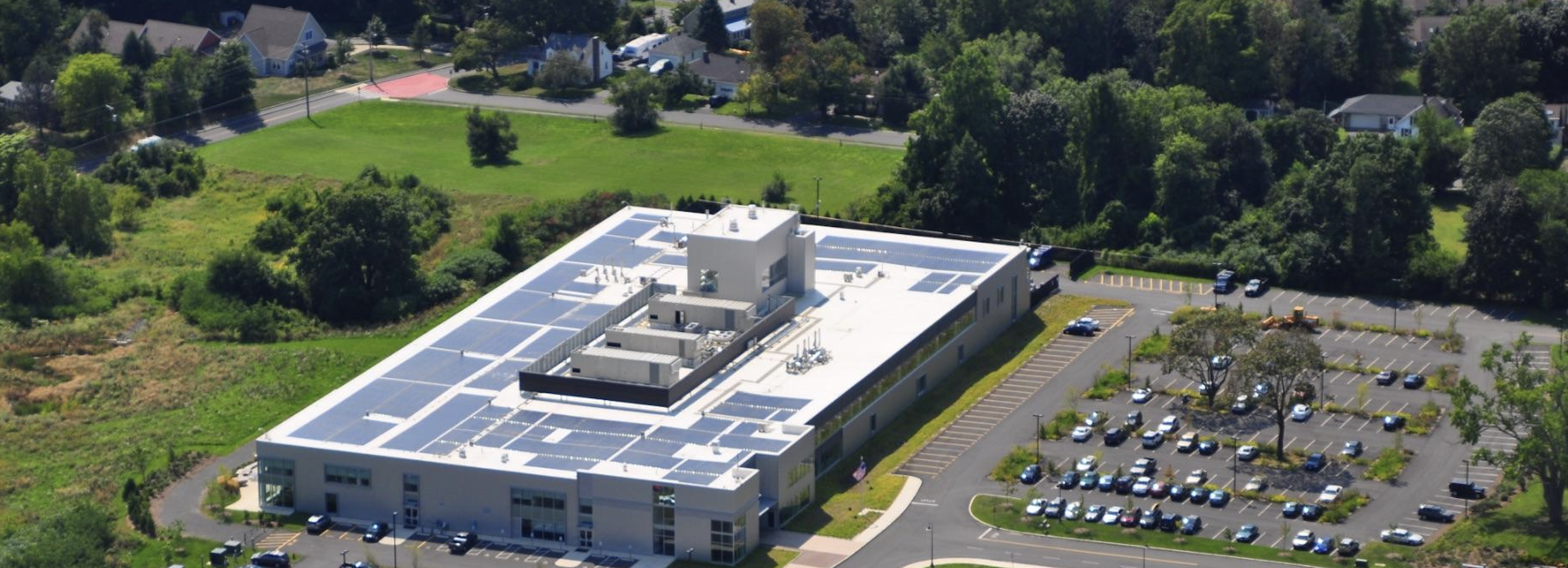
FAQ #1: “If L3Harris leaves Northampton, won’t we lose the tax revenue?”
Answer:
No. Northampton would not lose commercial property tax revenue if L3Harris left.
Commercial property taxes in Massachusetts are based on the assessed value of the real estate itself - the land and the building - not the business operating inside it.
That means:
A building is taxed the same amount regardless of who occupies it - L3Harris, a clean-tech firm, a life science company, a startup incubator, or anything else.
If the property is sold or leased to a new tenant, the tax bill stays the same unless a renovation changes the assessed value.
If the building is temporarily vacant, the owner still pays the full tax bill.
The only scenario where revenue is lost is if the property is legally abandoned and removed from the tax roll - which will not happen at a high-value advanced manufacturing site in downtown Northampton, especially one located near five world-class colleges and universities.
In short:
The tax revenue comes from the building, not the defense contractor.
The revenue stays. The risk does not.
FAQ #2: “If L3Harris leaves Northampton, won’t we lose the jobs?”
Answer:
No. The jobs do not disappear - they relocate.
If L3Harris moves its nuclear weapons systems related work out of a residential neighborhood, the positions shift to a more appropriate, secure military or naval location. They do not evaporate from the regional economy.
Here’s why:
L3Harris is not shutting down the program.
The photonics mast / submarine imaging work is under long-term Navy contract obligations. The work continues - it just needs to be done in a location suitable for defense manufacturing.Jobs tied to federal weapons systems follow the program, not the building.
Skilled positions (assembly, optics, testing, engineering, QA) would simply move to a better-suited site.The most likely relocation sites are:
Westover Air Reserve Base (Chicopee) - secure, industrial, close.
Westfield’s Barnes ANG Base - also secure & underutilized.
Groton, CT (Electric Boat submarine hub)
Newport, RI (Naval Undersea Warfare Center + submarine ecosystem)
These are existing, defense-compatible locations.
Workers are not fired.
Defense contractors retain their trained specialists.
Many employees would:commute,
transfer internally,
or remain with L3Harris in another division.
New jobs will fill the space here.
The Northampton building will not be empty for long.It would quickly be leased to:
advanced manufacturing firms,
clean tech,
medical device companies,
university spinouts,
A Five Colleges Center for Innovation & Entrepreneurship | Click for more information on this model
or R&D tenants.
In an area surrounded by five colleges and a workforce pipeline, the space is valuable and in demand.
Northampton does not lose workers - it gains safety.
What leaves is the nuclear weapons - related risk, not employment.
FAQ #3: “Don’t L3Harris employees support the local economy?”
Answer:
People imagine that L3Harris employees stroll downtown, shop locally, eat in restaurants, and support cafés - but in reality, the economic impact on Northampton is extremely small.
Here’s why:
The facility is secure-access, meaning workers stay inside during the workday.
Many bring lunch, minimizing any interaction with local businesses.
There is no foot traffic that spills into downtown.
The company does not draw customers or visitors into Northampton the way a hospital, university, coworking hub, arts venue, or innovation space would.
The site is not mixed-use - it’s a standalone, closed industrial building with no public interface.
So yes - the real economic impact is essentially “someone buys a slice of pizza.”
That’s not dismissive; it’s the actual scale of local benefit.
FAQ #4: “Why are you calling for relocation instead of demanding that L3Harris KEO shut down this work entirely?”
Answer:
Because shutting it down is not a realistic outcome - and pretending otherwise does not reduce risk.
L3Harris is one of the largest defense contractors in the United States, with tens of thousands of employees and legally binding contracts tied to critical national security systems, including the $348,000,000,000 Columbia-class ballistic missile submarine program. The work performed at the Northampton facility is highly specialized and cannot simply be discontinued by protest or local pressure.
That means:
If the Northampton facility were to close, the work would not stop.
The contracts would have to be fulfilled elsewhere.
The only options are relocation to another community or consolidation at an existing military base.
Since the facility does work connected to submarine programs in Groton, Connecticut, relocation would not be far.
In contrast to calls for shutdown, relocation is a concrete, enforceable outcome that cities can realistically pursue using the authority they actually have.
In short:
The work will continue either way. The question is where it happens.
FAQ #5: “Does relocating L3Harris actually reduce risk, or just move it?”
Answer:
Relocation reduces civilian risk, even though it does not eliminate broader strategic risks that lie outside municipal control.
The purpose of relocation is not to claim that war is avoidable or that global military dangers disappear. It is to avoid concentrating sensitive, high-risk defense work in a dense residential neighborhood that was never designed to absorb it.
Relocation matters because it:
Removes a high-value military target from a civilian population center
Aligns sensitive defense work with military or secure industrial sites designed to handle it
Consolidates risk rather than embedding it in everyday civilian life
Reduces day-to-day accident and emergency-response risk unrelated to war
None of this suggests that relocation makes conflict “safe.” It reflects the reality that cities can reduce local, preventable risk even when larger strategic dangers remain beyond their authority.
In short:
Relocation doesn’t eliminate global military risk. It prevents civilians from being asked to absorb unnecessary local risk.
FAQ #6: “Do they work on nuclear weapons at L3Harris KEO in Northampton?”
Answer:
No. L3Harris KEO in Northampton does not manufacture nuclear weapons - meaning no nuclear warheads, no physics packages, no nuclear explosives, and no bomb or missile assembly.
Under current international arms control frameworks, the United States maintains roughly 1,550 deployed strategic nuclear warheads. These weapons are designed, built, and maintained at highly specialized national laboratories and production sites - not in Northampton.
What happens in Northampton is different - but still directly tied to how those weapons are deployed.
The Northampton facility designs and produces advanced submarine imaging, photonics, masts, and ISR systems (Intelligence, Surveillance, and Reconnaissance) that serve as the “eyes and sensors” of U.S. ballistic missile submarines. These systems support submarines whose sole mission is first-strike survivability and assured second strike - the core of nuclear deterrence.
Specifically, the work is connected to:
Ohio-class ballistic missile submarines (SSBNs)
Each Ohio-class SSBN carries 20 Trident II D5 missile tubes (reduced from 24 under arms-control agreements).
Each Trident missile can carry multiple nuclear warheads, typically with explosive yields in the hundreds of kilotons (commonly cited ranges are roughly 100–475 kilotons per warhead).
These submarines have long been described as the most survivable and most destructive weapons system ever deployed, designed to remain hidden and guarantee retaliation even after a nuclear first strike.
Columbia-class ballistic-missile submarines (SSBNs)
The Columbia class will replace the Ohio class as the sea-based leg of the U.S. nuclear triad.
Each Columbia-class submarine will carry 16 Trident II missile tubes, with the same strategic role: ensuring a survivable second strike under any circumstances.
L3Harris systems produced in Northampton are part of the next-generation sensor and mast architecture that enables these submarines to operate undetected and fulfill that mission.
These systems do not contain nuclear material and are not weapons themselves, but they are critical to the operation, survivability, and effectiveness of nuclear-armed submarines.
In short:
L3Harris is not building nuclear weapons in Northampton. It is building critical ISR and imaging systems for the submarine platforms that launch them - the backbone of the most destructive weapons system on Earth.